

UNDERSTANDING THE TIMES
What is the Gift of Understanding?
"Understanding the times" is one of those phrases from the Bible which is frequently quoted (especially in prophetic speculation circles), but seldom analyzed.
It comes from 1 Chronicles, chapter 12. This gift of understanding is attributed to the 'sons of Issachar' -- that is, a group of elders from the tribe of Issachar. Issachar was one of the 12 tribes of Israel, descended from Jacob's 12 sons. What we learn in the book of Chronicles is that this tribe had insight which the other tribes lacked. This insight helped the nation to make the right decision at a critical time in Israel's history: it helped the nation unify behind David and declare him to be the king who would succeed Saul. This was by no means a forgone conclusion, humanly speaking. God had chosen David to be the king, but under the polity of Israel, the people must also choose the king and install him. Samuel Rutherford, the great Scottish theologian, noted this in Lex Rex (Latin for 'The Law is King') and it became part of the basis for America's adoption of self-rule.
I first read that phrase 'understanding the times' when I saw it 20 years ago as the title of an excellent book about world views from David Noebel, founder of Summit Ministries. But how did Issachar manage to acquire this special knowledge? Why was it Issachar, especially, that had this gift? One might expect it to be Levites who served God in the temple. But it wasn't Levi; it was Issachar. I reasoned that maybe if we could learn how Issachar developed this capacity for understanding then we could be imitators who could undergo the same sort of spiritual and leadership development and thereby be given the same gift of understanding. The Christian church in the 21st century seemed to me to be desperately in need of such a gift, and I set out to learn what it was about Issachar that led them to it. In the 20 years that I've spent struggling with this question, I believe that the need for understanding of the times has only grown more desperate.
Here's what two decades of study has taught me.
Let's start with the verses:
"And of the children of Issachar, which were men that understood the times, to know what Israel ought to do; the heads of them were two hundred; and all their brethren were at their commandment. Of Zebulun, such as went forth to battle, expert in war, with all instruments of war, fifty thousand, which could keep rank: they were not of double heart." 1 Chronicles 12:32-33.
So, in 1 Chronicles 12, Israel was having its election. It was choosing between two dynasties, the Davidic and the Saulide. (Of course, we Americans have no experience with political dynasties, right?) The tribe of Issachar knew which way to go and helped lead the other tribes to shift towards the next era, the era of David and his successors.
According to numerous Jewish sources, Issachar was the tribe which focused on the study of the Torah. Issachar was teamed with Zebulun which was the commercial tribe. Zebulun sailed the seas and traded (which Moses prophesied over them in Dt. 33) while Issachar dwelt in Zebulun's tents (also predicted by Moses).
There are two key prophecies made over Issachar and Zebulon. The first was given to the patriarchs themselves from their direct father, Jacob; the second was much later when both were mature tribes and Moses was giving his own final blessing over them.
Jacob's blessings over Zebulun and over Issachar
“Zebulun will live by the seashore.
and become a haven for ships.
his border will extend toward Sidon.
14 “Issachar is a rawboned[f] donkey
lying down among the sheep pens. [g]
15 When he sees how good his resting place is.
and how pleasant is his land,
he will bend his shoulder to the burden.
and submit to forced labor.""
Moses' blessings over Zebulun/Issachar
"18 About Zebulun he said:
“Rejoice, Zebulun, in your going out,
and you, Issachar, in your tents.
19 They will summon peoples to the mountain.
and there offer the sacrifices of the righteous.
they will feast on the abundance of the seas,
on the treasures hidden in the sand.”"
Although prophetic utterances are to some degree difficult to understand (especially for we modern commentators who do not naturally think in the same ways as ancient people) nevertheless we clearly see a close partnering between these two tribes. They are children of the same mother and adjacent in birth order. In addition, they were in the same cluster together in the encampments around the tabernacle and once the tribes settled in Israel their territories were next to one another. We also clearly see evidence of a commercial aspect to Zebulun's special calling in the division of labor between the tribes. According to Josephus, Zebulun bordered the sea, and although some scholars differ, even those scholars place Issachar next to sea-side territories. Either way, both scripture and Rabbinical and other historical sources identify them as sea-going traders. Jacob's prophecy above seems to imply that as well, and Moses' later prophecy is certainly consistent with that.
Issachar's prophecies are somewhat less clear. He will engage in some sort of labor, according to Jacob's final blessing, and according to Moses, he will do that in close partnership with Zebulun. The ancient sources are nearly unanimous in concluding that Issachar's special labor was Torah study. They were, according to Rashi and Josephus, a scholarly tribe.
"Zebulun and Issachar entered into a partnership: Zebulun dwelt at the harbor of ships and went out in ships to trade; he made profit and used to provide food for Issachar who sat at home and occupied themselves with the Torah. Consequently, he mentioned Zebulun before Issachar (although the latter was the elder) because Issachar’s knowledge of Torah was due to Zebulun."
This quote is one of several from the great Rabbi. They can be found here.
Zebulun's commercial activity made Issachar's scholarship possible. The consistent pairing of Issachar and Zebulun in scripture is important. They marched on either side of Judah before the Ark of the Covenant. Their territories were adjacent when they settled in Israel. Zebulun according to some sources reached to the sea, other sources say they reached as far as Sidon, which reached to the sea. In either case they were sea-going merchants. This is important: there was a close partnership between scripture scholarship and business.
My friend Rabbi Daniel Lapin tells me that even to this day, a businessman who sponsors a Torah student is called a Zevulun, in recognition of the historical record.
But I don't think the original arrangement was a donor-beneficiary one. Throughout history we see that when there is a scholarly tribe or class in a society, they're never only scholars. As literate people, ancient scholars had other important functions: they kept records, births, marriages, business arrangements such as debts, collections, assets. That's why the same English word 'clerical' refers to ordained religious leaders and also to bookkeepers. A cleric is a minister, a clerk files papers.
What I see is that out of all the tribes of Israel, the one which devoted itself to the study of the scriptures, but which also almost certainly kept the financial books and commercial records of the commercial tribe with whom they were partnered was the one which alone 'knew understanding to the times' (literal translation of the passage).
Understanding springs out of that zone of the overlap between knowledge of the Scriptures and knowledge of the business affairs of the world. Scholars insulated from the marketplace become ivory tower hermits (or far from the front lines revolutionaries). People immersed in the marketplace without reference to the permanent truths of the writings, can never get a view of the big picture.
But bring those two together, and you understand the times and knowledge of what to do.
According to the ancient Jewish historian, Josephus, the region of Zebulon is partly in what would later be called Galilee:
"Wars of the Jews 2:503 so Cestius took part of his forces and marched hastily to Zebulun, a strong city of Galilee, which was called the City of Men, and divides the country of Ptolemais from our nation;"
(Wars 2:503 JOE)
Jesus was a man (but not only a man) who 'does all things well'. He lived in Nazareth, which was a suburb of Sephoris, the financial capital of northern Palestine. His parables show a shockingly sophisticated level of knowledge about the state-of-the-art finance in his day. He was a Rabbi, but he was around business as a builder. The people of Nazareth were within walking distance of Sephoris -- which, during Jesus' life there, was undergoing a massive rebuilding project due to the fact that the city had been destroyed by the Romans after a brief unsuccessful Jewish revolt. So, he grew up in an environment immersed in business activity. Although he was of the tribe of Judah, He had in Himself the best of all the tribes, and so was a true Issacharian in being a study of the Scriptures and a thinker who more than any other understood the times.
After 20 years of reflection on this question, I have concluded that the zone of understanding the times is the zone in which Scripture study and engagement with commerce overlap. It is not isolated scholarship with its tendency to obscurity and otherworldliness alone; nor is it a constant immersion in the flux of second-to-second market data. But rather the permanent theological framework of the Bible interpreting the data of business traders (who get to see so much of the world and to meet so many people and who must pay so much attention to risk factors) together which call us 'men who understand the times and know what Israel ought to do'.
WHAT CAN LEARN FROM THE ISSACHAR TRIBE?
Part 1
Recommended Resource: The Quest Study Bible
Answer: Each of the twelve sons of Israel received a blessing from his father, Jacob, just before Jacob’s death. The twelve sons were the Ancestors of the Twelve tribes of Israel, and Jacob’s blessings contained prophetic information about each tribe. In the case of the tribe of Issachar, Jacob prophesied, “Issachar is a rawboned donkey, lying down between two burdens; He saw that rest was good, and that the land was pleasant; He bowed his shoulder to bear a burden, and became a band of slaves” (Genesis 49:14-15).
The first part of the prophecy about the tribe of Issachar, whose name means either “he will bring a reward” or “man of wages,” is somewhat obscure. The word translated “rawboned” in the NIV is translated “strong” in other versions. It can also mean “bony” as in “nothing but skin and bones.” Therefore, the prophecy could either mean that the descendants of Issachar would be strong and robust, able to bear burdens, or that they would be thin, weak, and unable to do so.
The image of a donkey lying down between its burdens can also be interpreted two ways. On one hand, it could portray a sturdy animal resting for the task ahead. On the other hand, donkeys also are known to stubbornly crouch between their burdens to keep from having to do the work! Again, the prophecy eludes a dogmatic interpretation. The subsequent history of Issachar in the Bible does not conclusively favor either construal.
As for the second part of the prophecy, some commentators believe it is an indication that the descendants of Issachar would be farmers—the reference to “a band of slaves” means they would be servants of the land. Others see it as a prediction of forced labor, although nothing in Scripture shows that the tribe of Issachar was ever forced into slavery of any kind. In fact, the Hebrew wording is so obscure that English translations vary widely. Consider the following:
KJV: “Issachar is a strong ass couching down between two burdens: And he saw that rest was good, and the land that it was pleasant; and bowed his shoulder to bare, and became a servant unto tribute.”
ESV: "Issachar is a strong donkey, crouching between the sheepfolds. He saw that a resting place was good, and that the land was pleasant, so he bowed his shoulder to bear, and became a servant at forced labor.”
NASB: “Issachar is a strong donkey, Lying down between the sheepfolds. When he saw that a resting place was good and that the land was pleasant, He bowed his shoulder to bear burdens, and became a slave at forced labor.”
NIV: “Issachar is a rawboned donkey lying down between two saddlebags. When he sees how good his resting place is and how pleasant is his land, he will bend his shoulder to the burden and submit to forced labor.”
MSG: Issachar is one tough donkey crouching between the corrals; 15 When he saw how good the place was, how pleasant the country, He gave up his freedom and went to work as a slave.
There is another reference to the men of Issachar during the time of David’s struggle against Saul (1 Chronicles 12:32). The two hundred chiefs of Issachar who are faithful to David are described as those who “understood the times and knew what Israel should do.” Scholars are divided on the meaning of the phrase “understood the times.” Some portray the men of Issachar as politically astute, knowing how to use current events to their own advantage. Others interpret the phrase to mean they were known for their understanding of astronomy and physical science. Still others see them as men of prudence and wisdom who, because of their religious scholarship, knew that this was the proper time for David to become king. The truth is that we really do not know for sure.
As part of the Northern Kingdom of Israel, the territory of Issachar was conquered by the Assyrians around 720 B.C. and the tribe exiled. After that, all explicit biblical references to the tribe cease.
How are we to understand these references to Issachar and their different interpretations, and what do they mean to us as Christians? First, it is important to understand that Jacob’s prophecies to his sons were just that—prophecies to his sons. We should be incredibly careful when applying Old Testament passages to the Church Age or to Christians in general. We can, however, glean certain general principles about work and its rewards. The Bible makes it clear that work is a gift from God for the benefit of His people (Ecclesiastes 3:12-13; 5:18-20) and those who do not work should not eat (2 Thessalonians 3:10). The Bible contains numerous references to those who work as reaping rewards, both in the temporal and spiritual realms (2 Chronicles 15:7; 1 Corinthians 3:8,14; 2 John 1:8; Revelation 2:23; 22:12).
There are some who would point to the different translations of Genesis 49:14-15 as evidence of the unreliability of the Bible. However, it must be remembered that such cases of obscurity are extremely rare, and none of the cardinal doctrines of the Christian faith are ever in question. Whether the donkey was bony or robust does not affect the Bible’s teaching on sin, death, judgment, heaven, hell, the atonement of Christ, or a myriad other doctrine. Scripture holds ample information about these doctrines to make them clearly understood to all who have “ears to hear” (Mark 4:9, 23).
WHAT CAN WE LEARN FROM THE TRIBE OF ISSACHAR PT 2
IMPORTANT THINGS TO REMEMBER
The sons of Issachar had analyzed their times and had perceived correctly what those times were all about. They knew what to do because they understood what was happening. It was obvious to them that Saul had not been a good king and there was no established dynasty to keep the kingship in the tribe of Benjamin.
1
I believe that the children of Issachar had understanding of prophecies and the occurrences at any time to know what point they were on in the plan of God for their nation. All Israel was aware that David was anointed as king of Israel but could not mount the throne because Saul was still on the throne. On seeing the events that had occurred in the country in those times, they realized that it was time for the Lord's choice of king to be enthroned. While the rest of Israel was in confusion as on what to do next, they understood that it was time for Israel to acknowledge and make David their king.
Jewish writers say that the people of this tribe were eminent for their acquirements in astronomical and physical science; and the object of the remark was probably to show that the intelligent and learned classes were united with the military, and had declared for David.
DAILY READING: 1 CHRONICLES 12 - 14
TEXT: 1Ch 12:32 And of the children of Issachar, which were men that had understanding of the times, to know what Israel ought to do; the heads of them were two hundred; and all their brethren were at their commandment. 1Ch 12:33 Of Zebulun, such as went forth to battle, expert in war, with all instruments of war, fifty thousand, which could keep rank: they were not of double heart.
THEME: WISDOM
It is not until we read of David as king of Israel do the Scriptures in 1st Chronicles begin to open in a more detailed fashion. Further, we see the value of multiple accounts of Biblical principles or characters as we observe in the Gospel of Jesus Christ. Jesus life and work are told in four complimentary accounts of His life where details omitted in one report is furnished in the other. Thus, its pleased God to use men to fulfill His own law - "by the mouth of two or three witnesses let every word be established." The usefulness of composite versions of Biblical history then, is the supply of more facts, features, and specifics of what God wants us to know.
The greater part of 1st Chronicles concerns the life of David as king of Israel. Hence, we receive further elucidation, clarification, and illumination on his life. At least from the time he became king. Albert Barnes tells us -
This chapter is composed wholly of matter that is new to us, no corresponding accounts occurring in Samuel. It comprises four lists:
(1) One of men, chiefly Benjamites, who joined David at Ziklag 1Ch_12:1-7.
(2) A second of Gadites who united themselves to him when he was in a stronghold near the desert 1Ch_12:8-15.
(3) A third of Manassites who came to him when he was dismissed by the Philistines upon suspicion 1Ch_12:19-22; and
(4) A fourth of the numbers from the different tribes who attended and made him king at Hebron 1 Chr. 12:23-40.
Thus, Mathew Henry gives us some application of this chapter.
"Here is an account of those who appeared and acted as David's friends, while he was persecuted. No difficulties or dangers should keep the sinner from coming to the Savior, nor drive the believer from the path of duty. Those who break through, and overcome in these attempts, will find abundant recompence. From the words of Amasai we may learn how to testify our affection and allegiance to the Lord Jesus; his we must be thoroughly; on his side we must be forwarded to appear and act. If we are under the influence of the Spirit, we shall desire to have our lot among them, and to declare ourselves on their side; if in faith and love we embrace the cause of Christ, he will receive, employ, and advance us."
TRUTH FOR TODAY: WE NEED TO BE PEOPLE WHO UNDERSTAND THE TIMES AND KNOW WHAT TO DO!
Our text states the men of Issachar understood their times and knew what Israel should do. Perhaps there is no other quality worthy of our desire to possess than this one. We have a great need of this attribute today. Jesus reproved the Pharisees for not having a knowledge of their times, and therefore, not responding properly to His presence among them.
"And in the morning, it will be foul weather today: for the sky is red and low ring. O ye hypocrites, ye can discern the face of the sky; but can ye not discern the signs of the times?" [Mat_16:3]
If Jesus reproved them, it is certain He would exhort or reprove His Church today, particularly His leaders for the same reason. In the face of mounting evidence that Christ will return soon, His Church, or at least those that profess His Name, are living in contradiction to the explicit commands and instruction of those who call Him Lord.
Some believe the men of Issachar were astrologers, who knew what "political" strategies to employ. Such proponents of this view are Albert Barnes, and Adam Clarke.
"Men that had understanding of the times - This is best interpreted politically. Compare the marginal reference" [Albert Barnes]
"Children of Issachar - According to the Targum they were all astronomers and astrologers: "and the sons of Issachar, who had understanding to know the times, and were skilled in fixing the beginnings of years, the commencement of months, and the intercalation of months and years; skillful in the changes of the moon, and in fixing the lunar solemnities to their proper times; skillful also in the doctrine of the solar periods; astrologers in signs and stars, that they might show Israel what to do; and their teachers were two hundred chiefs of the Sanhedrin: and all their brethren excelled in the words of the law, and were endued with wisdom, and were obedient to their command." - T. It appears that in their wisdom, experience, and skill, their brethren had the fullest confidence; and nothing was done but by their direction and advice." [Adam Clarke]
However, the text does not state that specifically. Therefore, we may understand it in another sense. Either way, we can take a lesson from these men in a spiritual, moral, doctrinal, and theological application. In the New Testament, we are repeatedly exhorted and warned how to believe and behave as Christ approaches to judge all men. John Darby enlightens us.
"Now the Son of man, in His day, would be like the lightning: but, before that, He must suffer many things from the unbelieving Jews. The day would be like that of Lot, and that of Noe: men would be at ease, following their carnal occupations, like the world overtaken by the flood, and Sodom by the fire from heaven. It will be the revelation of the Son of man — His public revelation — sudden and vivid. This referred to Jerusalem. Being thus warned, their concern was to escape the judgment of the Son of man which, at the time of His coming, would fall upon the city that had rejected Him; for this Son of man, whom they had disowned, would come again in His glory. There must be no looking back; that would be to have the heart in the place of judgment. Better lose all, life itself, rather than be associated with that which was going to be judged. If they should escape and have their lives spared through unfaithfulness, the judgment was the judgment of God; He would know how to reach them in their bed, and to distinguish between two that were in one bed, and between two women who ground the corn of the household at the same mill.
This character of the judgment shews that it is not the destruction of Jerusalem by Titus that is meant. It was the judgment of God that could discern, take away, and spare. Neither is it the judgment of the dead, but a judgment on earth: they are in bed, they are at the mill, they are on the housetops and in the fields. Warned by the Lord, they were to forsake all, and to care only for Him who came to judge. If they asked where this should be — wherever the dead body lay, there would be the judgment that would come down like a vulture, which they could not see, but from which the prey would not escape."
We are also told -
1st. 5:1 But of the times and the seasons, brethren, ye have no need that I write unto you. 1Th. 5:2 For yourselves know perfectly that the day of the Lord so cometh as a thief in the night. 1Th. 5:3 For when they shall say, Peace and safety; then sudden destruction cometh upon them, as travail upon a woman with child; and they shall not escape. 1Th. 5:4 But ye, brethren, are not in darkness, that that day should overtake you as a thief. 1Th. 5:5 Ye are all the children of light, and the children of the day: we are not of the night, nor of darkness. 1Th. 5:6 Therefore let us not sleep, as do others; but let us watch and be sober.
John Darby again explains.
"The Lord's coming again into this world assumes therefore a very different character from that of a vague object of hope to a believer as a period of glory. In Chapter 5 the apostle speaks of it, but in order to distinguish between the position of Christians and that of the careless and unbelieving inhabitants of the earth. The Christian, alive and taught of the Lord, ever expects the Master. There are times and seasons; it is not needful to speak to him concerning them. But (and he knows it) the day of the Lord will come and like a thief in the night, but not for him: he is of the day; he has part in the glory which will appear in order to execute judgment on the unbelieving world. Believers are the children of light; and this light which is the judgment of unbelievers, is the expression of the glory of God — a glory which cannot endure evil, and which, when it shall appear, will banish it from the earth. The Christian is of the day that will judge and destroy the wicked and wickedness itself from off the face of the earth. Christ is the Sun of righteousness, and the faithful will shine as the sun in the kingdom of their Father.
The world will say, "Peace and safety," and in all security will believe in the continuance of its prosperity and the success of its designs, and the day will come suddenly upon them. (Compare 2Pe_3:3.) The Lord Himself has often declared it. (Mat_14:36-44; Mar_13:33-36; Luk_12:40, &c.; Luk_17:26, &c.; Luk_21:35, &c.)
ISSACHAR SERIES
continued
WHAT CAN WE LEARN FROM THE TRIBE OF ISSACHAR? PART 3
continued from part 2
It is a very solemn thing to see that the professing church (Rev_3:3) which says that it lives and is in the truth, which has not Thyatira's character of corruption, is yet to be treated as the world — at least, unless it repents.
We may perhaps wonder to find the Lord saying of a time like this, that men's hearts will be failing them for fear, and for looking after those things that are coming on the earth. (Luk_21:26) But we see the two principles — both security and fear — already existing. Progress, success, the long continuance of a new development of human nature — this is the language of those who mock at the Lord's coming; and yet beneath it all, what fears for the future are at the same time possessing and weighing down the heart! I use the word "principles," because I do not believe that the moment of which the Lord speaks is yet come. But the shadow of coming events falls upon the heart. Blessed are they that belong to another world!
The apostle applies this difference of position — namely, that we belong to the day, and that it cannot therefore come upon us as a thief — to the character and walk of the Christian. Being a child of the light, he is to walk as such. He lives in the clay, though all is night and darkness around him. One does not sleep in the day. They that sleep, sleep in the night: they that are drunken are drunken in the night; these are the works of darkness. A Christian, the child of the day, must watch and be sober, clothing himself with all that constitutes the perfection of that mode of being which belongs to his position — namely, with faith and love and hope — principles which impart courage and give him confidence for pressing onwards. He has the breastplate of faith and love; he goes straight forward therefore against the enemy. He has the hope of this glorious salvation, which will bring him entire deliverance, as his helmet; so that he can lift his head without fear amid danger. We see that the apostle here recalls the three great principles of 1 Corinthians 13 to characterize the courage and steadfastness of the Christian, as at the beginning he shewed that they were the mainspring of daily walk.
Faith and love naturally to connect us with God, revealed as He is in Jesus as the principle of communion; so that we walk with confidence in Him: His presence gives us strength. By faith He is the glorious object before our eyes. By love He dwells in us, and we realize what He is. Hope fixes our eyes especially on Christ, who is coming to bring us into the enjoyment of glory with Himself.
Consequently, the apostle speaks thus: "For God hath not appointed us to wrath " (love is understood by faith, that which God wills — His mind respecting us) "but to obtain salvation." It is this which we hope for; and he speaks of salvation as the final deliverance "by our Lord Jesus Christ :" and he naturally adds, "who died for us, that whether we wake or sleep" (have died before His coming or be then alive), " we should live together with Him." Death does not deprive us of this deliverance and glory; for Jesus died. Death became the means of obtaining them for us; and if we die, we shall equally live with Him. He died for us, in our stead, in order that, happen what may, we should live with Him. Everything that hindered it is put out of our way and has lost its power; and, more than lost its power, has become a guarantee of our unhindered enjoyment of the full life of Christ in glory; so that we may comfort ourselves — and more than that, we may build ourselves up — with these glorious truths, through which God meets all our wants and all our necessities. This (1Th.5:10) is the end of the special revelation regarding those who sleep before the coming of the Lord Jesus, beginning with 1Th.4:13.
I would here call the reader's attention to the way in which the apostle speaks of the Lord's coming in the different Chapters of this epistle. It will be noticed that the Spirit does not present the church here as a body. Life is the subject — that of each Christian therefore individually: a very important point assuredly."
ISSACHAR ANOINTING TEST
Note this test is one the Google Forms site. That is where the answers will be submitted. This ism to assist in your study.
This is just a copy of the quiz so you can check your answers before submitting them on the test.
**PLEASE REMEMBER to include at least (1) one scripture on the answers that allow you to write out your response. IT WILL BE MARKED WRONG WITHOUT a verse!
1-Who was Issachar?
2-Who was Issachar Parents?
3-What was the blessing bestowed upon Issachar?
a-To be a part of Yah's chosen people.
b-To never be required to partake in physical labor.
c-To be full of wisdom.
d-To have discernment and wisdom in spiritual as well as governmental matters and know what was best for the people to do at that time.
4- What other tribe was to be of assistance to Issachar?
5- What area of study was Issachar well versed in?
A-Astrology
B- Meteorology
C-Astronomy
D- Torah and law with government and current events.
6-Issachar were Levite Priests
True
False
7-We need to have Issachar Anointing today to lead the people in the way they should go.
Option 1 True, Today we need to be lead by leaders because it's to scary to move by yourself.
Option 2 False While we need shepherds who hear, We now can seek Yah for ourselves.
Option 3 We must study and develop relationship and the Ruach will grant us wisdom and guide us.
Option 4 None of the above
8- How did Issachar ministry bring about the divine will of Yahweh?
9- What was different about this tribe?
10- Name 4 correlating "gifts present within the Issachar tribe that we today can receive as "Gifts of the Spirit"
11- Do you think we can have this type of Anointing today? Why?
12- In the "Church of what's happening now" Can you name three ministries that may possibly have this anointing? Why
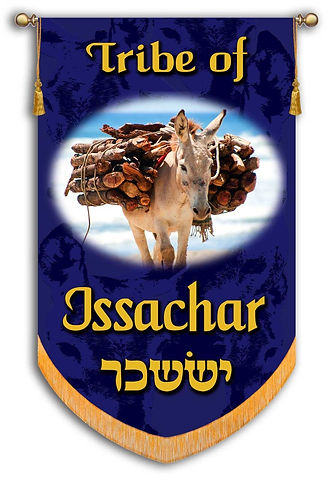
13- Explain why Issachar had this as their Banner?
NEW SERIES STARTING SOON
New Addition
We will be embarking on our War Chest Series Soon, so stay tuned!
ISSACHAR SERIES
This series is devoted to the Tribe of Issachar's purpose, place and characteristics. Discovering their ministry and unearthing the tremendous insight into the use of this ministry for todays beltevers.
THE STRONG-BONED ASS
The blessing of Issachar
An Excerpt from CGWKBK 5 Vol. 1: Vayechi-Blazing Saddles
The Strong-boned Ass
Issachar is a strong donkey, lying down between the sheepfolds. When he saw that a resting place was good and that the land was pleasant, he bowed his shoulder to bear burdens, and became a slave at forced labor. (Genesis 49:14-16)
Issachar's blessing has much in common with Judah's. Both are described as crouching down, Judah as a lion and a royal warrior, and Issachar as a donkey between the sheepfolds, a prophet-shepherd. Issachar lies down to guard the two sheepfolds, perhaps Israel and Judah or the native born to the covenant and those from the nations who would join themselves to Israel.
Donkeys are often turned out to pasture with cattle or other livestock to protect them from coyotes or other predators. They not only work hard, but they are fiercely protective of the herd. The name Yissachar means a reward, or repayment, a wage. With Judah and Issachar, we see a paradox of the Kingdom of Heaven. Rulership is the reward of humility, service, and patience, the spirit of prophecy.
Issachar's blessing was to be an ass: to serve, bow, protect the sheep, and perform hard work. Yet, his very name implies that he will be rewarded for this seemingly mundane blessing. To serve one another is a blessing, and it is the spirit of prophecy because those who serve are doing the deeds of Yeshua. This steady, patient service is necessary in the assemblies of Adonai because it was the tribe of Issachar who was faithful in times of war. The lowly ass is the same symbol for the Jewish warrior who washes his robes in the blood of grapes, a metaphor for war in the Prophets.
Judge Deborah's and Barak's fight against the iron chariots of Sisera was not fought with pride, but humility. Deborah didn't fight back with horses of pride, she saddled her ass and fought back with strong-boned donkey servants: the tribe of Issachar!
"And the princes of Issachar were with Deborah; as was Issachar, so was Barak; into the valley they rushed at his heels..."[1]
Wait a minute, wasn't it the tribe of Dan who was blessed with to strike at the horses' heels? But they stayed in their ships! Too lazy? Too busy with their own affairs? Didn't like Barak? Didn't want to follow a woman? What was it? Regardless, it was Issachar who exercised Dan's blessing in battle.
Later in Scripture the tribe of Issachar again is mentioned as great warriors, and again they are at the forefront of the army, rallying to the anointed king David to unite Israel, moving in the spirit of prophecy. 1 Chronicles 12:23-40 is one example:
Now these are the numbers of the divisions equipped for war, who came to David at Hebron, to turn the kingdom of Saul to him, according to the word of the LORD. Of the sons of Issachar, men who understood the times, with knowledge of what Israel should do, their chiefs {were} two hundred; and all their kinsmen {were} at their command.
All these, being men of war who could draw up in battle formation, came to Hebron with a perfect heart to make David king over all Israel; and all the rest also of Israel were of one mind to make David king. They were there with David three days, eating and drinking, for their kinsmen had prepared for them. Moreover those who were near to them, {even} as far as Issachar and Zebulun and Naphtali, brought food on donkeys, camels, mules and on oxen, great quantities of flour cakes, fig cakes and bunches of raisins, wine, oil, oxen and sheep.
The patience of a strong-boned ass is necessary to cultivate understanding of the times, especially the festival times for the King. The right thing can be done at the wrong time, but the wise, strong-boned ass discerns and rises up to protect the sheep at the right time.
The blessings on each tribe are not exclusive to each tribe. The tribes of Israel are the FAMILY of Israel. When someone refuses the job and forfeits that opportunity to operate in his or her blessing, then another family member may put her shoulder to the burden and carry it.
The example of Issachar is that the individual who submits to the less-than-glorious service to others will be raised up to war like the lion of Judah's blessing and Dan's tactical serpent biting the rider's heels and judging their people with wise chiefs.
The patient tribe of Issachar was blessed with:
the sword of Shimon and Levi because he was not cruel to the livestock, but protected them. He was not angry and vengeful like Shimon and Levi, but he knew that a resting place was good.
being able to put his hand on the neck of his enemies like Judah
being a tribe who discerns the times, so they can speak beautiful words like Naphtali
fighting like Gad, a troop raiding the enemy
being a wolf in war like Benjamin, tearing the enemy
the steady bow like Joseph
chiefs blessed with the wise dignity of the firstborn Reuven
Is it such a bad thing to become a servant to hard donkey labor, shepherding the flocks of sheep? This is the very preparation for difficult times. Patient study in the Word and a commitment to menucha, or creating resting place for Israel, is a prerequisite for understanding the times. Running to and fro to conspiracy theories or the latest internet "insight" is not preparation for troubled times. The patience of Issachar is preparation for tribulation.
What can the tribes teach us?
Not to be unstable. Not to run to and fro to new things. Don't pour yourself like water into the weird doctrine of the day.
Don't be angry and vengeful. Be kind even to animals.
Be so patient that you could be tied to the flimsiest vine without breaking away when distractions come.
Speak encouraging words.
Act quickly to do good, which burns up the enemy.
Share.
Aim at the real enemy, not brothers, and do not waver.
Conduct yourself with dignity.
Such traits characterize the family of Israel, for from there will come the Shepherd:
Rejoice greatly, O daughter of Zion! Shout in triumph, O daughter of Jerusalem! Behold, your king is coming to you; He is just and endowed with salvation, Humble, and mounted on a donkey, even on a colt, the foal of a donkey. (Zechariah 9:9)
Patiently bearing our burdens of protecting and pasturing the flocks leads to great skill in the day of battle. If we are a family, then my blessing is your blessing, and your blessing is mine. It's not MY ministry, it's OUR ministry. This is the family of Israel, "with a perfect heart to make David king over all Israel."
THE HISTORY OF THE TRIBE OF ISSACHAR
A look at the History of the Tribe
Instructor: Christopher Muscato
Chris has a master's degree in history and teaches at the University of Northern Colorado.
Cite this lesson
Each of the Twelve Tribes of Israel had its own role in the region. In this lesson, we'll see what the Tribe of Issachar was responsible for and the relevance of Issachar's role.
The Tribe of Issachar
Many people who have siblings have compared them to donkeys…of some variety. Turns out, there is an ancient precedent to this. The ancient history of Judaism tells of the Twelve Tribes of Israel, each one founded by a son of Jacob, the progenitor of the Israelites. These twelve brothers each had their own role in the family and the faith, but only Jacob's ninth son, Issachar, was known as the donkey of the group.
It's actually not as bad as it sounds. However, to understand it we need to take a deeper look into Issachar's life, and the group of Israelites who bore his name. The Tribe of Issachar was one of the Twelve Tribes of Israel, and later one of the Lost Tribes of Israel as well.
Signs of the Twelve Tribes, with the donkey representing Issachar
1] Issachar
So, who was Issachar? In the Jewish and Christian traditions, Issachar was Jacob's ninth son, who he had with one of his wives named Leah. Jacob's other wife at the time was named Rachel, who had problems conceiving. In exchange for some roots that would aid her fertility, Rachel traded one of her nights with Jacob to Leah. On that night, Issachar was conceived.
This history is important because Jewish sources say that Leah ''hired'' Jacob for the night, basically renting him from his other wife. Issachar's name, therefore, meant ''man of hire'', which implied a person whose labor could be bought or rented. From the moment of his conception, Issachar was destined to a life of manual labor.
The Blessing of Jacob
Before each Jacob's twelve sons left to form their own tribes, Jacob bestowed a prophetic blessing upon each of them. This blessing defined the characteristics and fortunes of each son, as well as the tribe that would bear their name for generations.
Jacob's blessing of Issachar went something like this:
Issachar is a strong donkey,
Lying down between two burdens;
He saw that the rest was good,
And that the land was pleasant;
He bowed his shoulder to bear a burden,
And became a band of slaves.
Issachar & the Tribe
Jacob's blessing for Issachar doesn't necessarily sound that great, but let's see what it really meant. First, Jacob describes Issachar's personality. This was significant since the personalities of the tribe's founders would long define the traits of that tribe. Issachar is defined as a strong donkey. This reaffirms descriptions of Issachar as somewhat wild and crass, like a wild donkey kicking and braying.
At the same time, however, a donkey is a beast of burden. Again, remember that Issachar's name even implied that his life would be one of labor. So, Issachar's personality was one of a worker with something of a wild side.
Issachar's personality translated into the fate of his tribe. As the blessing implies, Issachar's tribe found a pleasant land to settle in once the region of Canaan was conquered and divided between the twelve tribes. It was a fertile land, somewhere in the central spans of the region, and the Issachar people eventually became prosperous from their manual labor working the land. Due to this, they also became the third most populous of the tribes (according to biblical censuses), which could be reflected in Jacob's reference to them as a ''strong'' donkey
THE RETURN OF THE SON'S OF ISSACHAR
New Addition
When God said that he would shake everything that could be shaken so that our confidence would rest in Christ alone, he clearly meant it.
And for those with wisdom, such shaking, be it on a personal, national or international scale, is for our good. God is with the Church in a way that she does not understand or perceive – and is at work deep in the heart of the Church.
Looking at the world, and the shaking that is going on in every sphere of life, including the Church – it is not surprising that some raise the tentative question as to ‘where the Sons of Issachar are – those who understand the times and know what to do’. ( 1 Chr 12:32) It is a good question and one that deserves answering.
What is behind the story of the sons of Issachar?
Issachar was one of the 12 tribes of Israel whose name meant ‘He will bring a reward’. Some may find it amusing that Jacob refers to Issachar as ‘a strong ass crouching down between two burdens’! (Gen 49:14)
The tribe of Issachar were not the largest in Israel, and at the time of this incident in the life of King David, were considered to be around 87,000 warriors (1 Chr 7:5), but of all these, it is the 200 chiefs alone that had the reputation of ‘understanding of the times and what to do’.
Not all the tribe of Issachar were so gifted, 86,800 people remained, but they did have a degree of courage, bravery and to some extent, the wisdom to follow those who were leading them. And they were being led with wisdom, but the difficulty as always with mankind, is that even the 200 with their ability of understanding the times they faced and what to do, had shortcomings – and that is seen in 2 Chr 30:18 where Hezekiah had to pray for them because they approached the Passover feast with presumption, not observing the call for purity before participating in the feast.
Such short sightedness is prevalent throughout the Bible, the encouragement that we are to take care if we think we stand, less we stumble and fall, is a timely one for every generation of those whose hearts reach out for God.
Prophets or civil servants?
The bible introduces or refers to the prophets when they are mentioned using the titles, messenger, man of God, seer or Navi (prophet). The sons of Issachar are not mentioned in that way, and no predictive word, direction, correction or revelation is given by them to show otherwise. This was a time of political tension for David and Saul. The tribes were in a tremendous conflict and transition. The government was changing. And the prophets who do appear at this time are named, particularly Nathan and Gad.
They were moving from the government of the house of Saul to the government of the house of David. David was of Judah. Issachar could give great insight on how to make this shift. The Jewish teachings point to Issachar being a tribe having religious scholarship and intelligent men, well versed in political affairs, and knew what was proper to be done in all the exigencies of human life; and who now perceived that it was both the duty and political interest of Israel to advance David to the throne.
Do we need the a return of the sons of Issachar today?
We are careful to not go beyond what is written (1 Cor 4:6), but it is very clear as we look into scripture that something greater is with us today.
Instead of a minute number of people being able to clearly see what is going on, we are confronted by the majestic truth that Jesus has called us all into a place of privilege. Jesus has made things very clear to the entire Church on planet earth today, whether they choose to listen, read, hear or obey, how to know the times that we live in, and what to do (Matthew 24). Yahusua points to all the things that are happening and says, that when all these things occur, ‘look up, for your redemption draws near’. We are truly living in the end times.
So much has happened since 2011, rapidly and swiftly. We are truly seeing signs of the end times, but for the elect’s sake, those days will be shortened. It’s a call to be facing heaven, putting away sin – living resolutely and passionately for TMH (and many others!) have referred often for the need for us to be like the Sons of Issachar in these days – and what they mean is obvious and needful, but there is something more that we need to grasp. We are not merely a people looking at a world shaking and quaking under all that is happening, and we are certainly not just seeing the obvious, but we are above all else, a prophetic people – hearing from The Most High God.
The Bigger Picture
In these last days ( you can't get any latter than these days 2022 -2023) TMH God is pouring out His Spirit on all people, resulting in signs and wonders, dreams, visions and prophetic revelation. Why? Because Yahuah is looking at the times that we face and is revealing Himself, His will and His purpose to the Body of Christ so that we know what HE wants us to do! And not only that, but because He has adopted us (the Church) as sons we are called to work alongside Him as co-workers with Yahusua. The great commission is our ‘awesome co-mission’ with Him!
And every day, thousands more people on every continent of the planet join in this marvelous adventure